Table of Contents
Introduction
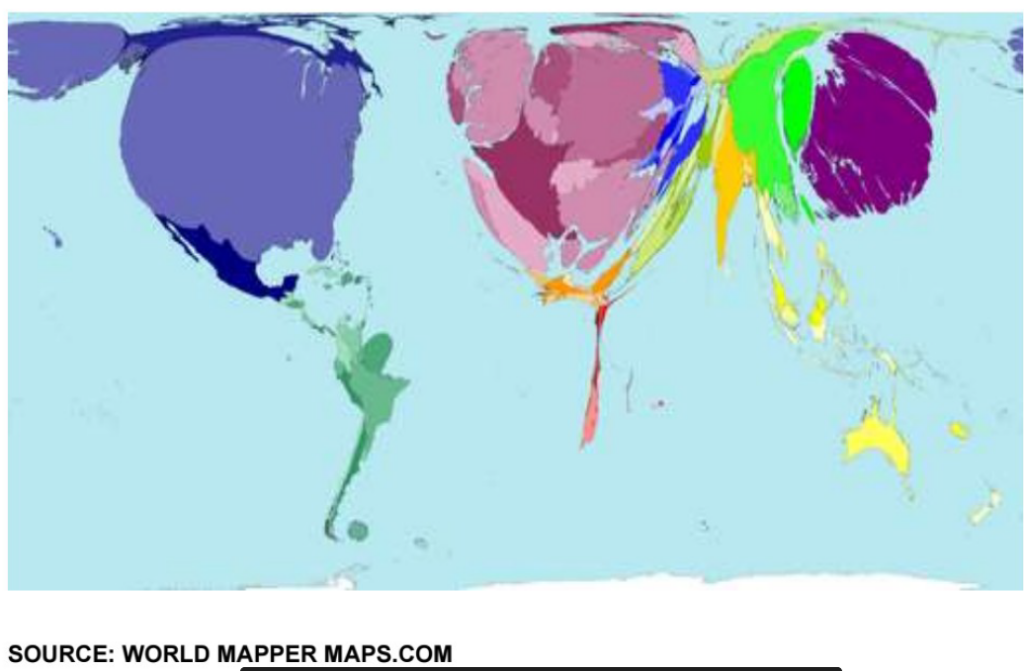
Foreigners are using Africa to source raw materials and produce so that they can create employment opportunities in their home countries and to create wealth by producing value-added products for home consumption and export.
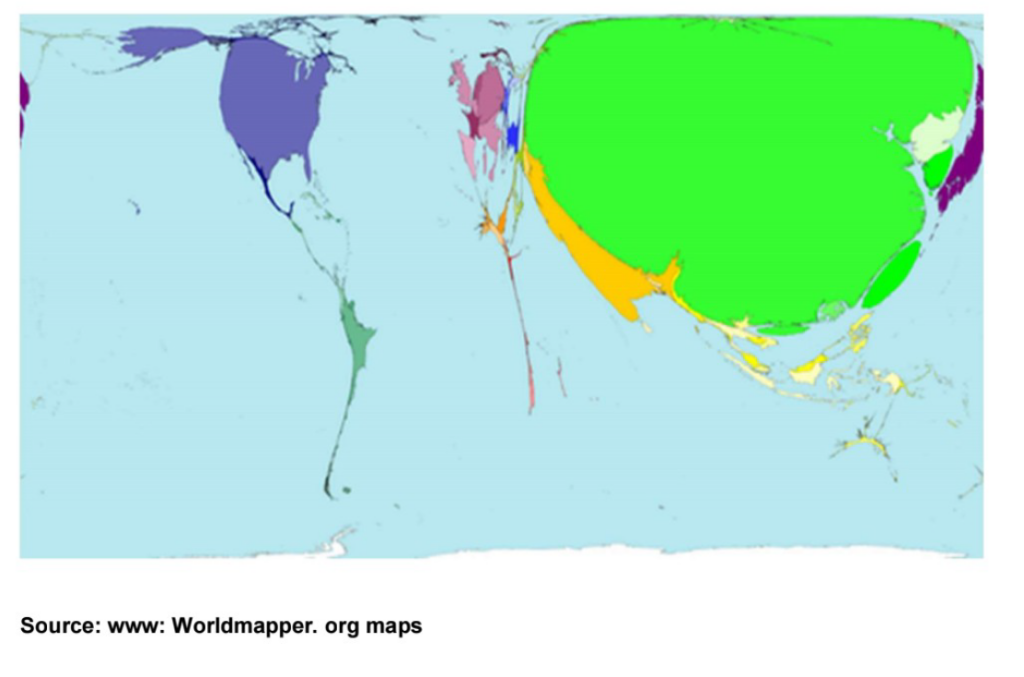
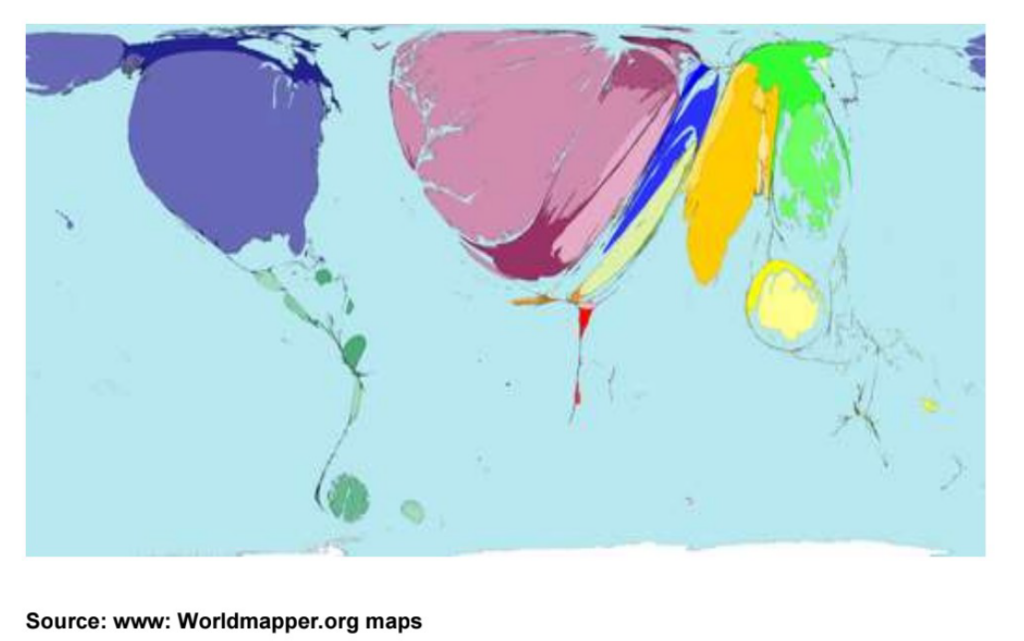
One needs only to look at the image below (the map resized according to value added exports) to see how Africa has been treated as a source of raw materials by the West, China and other Asian countries, to the detriment of value-added exports, wealth creation and the accompanying job opportunities.

Foreign intention to continue exporting value-added finished goods
Nothing demonstrates the intention of importers of raw materials better than to look at their investment in container terminals which are required for exports of finished value-added goods.
As can be seen from the map (resized by investment in container ports – China shown in green) and the US are major exporters of value added goods with the necessary investment in container ports. Africa, on the contrary, bulk terminals for raw material exports with no meaningful container export terminals/ports.
Africa’s share of export as a percentage of world trade
Impact of what foreigners think of South Africa
Firstly, we see the impact of their negative opinion in the behavior of the Rand, which, since 1994, has dropped as follows:
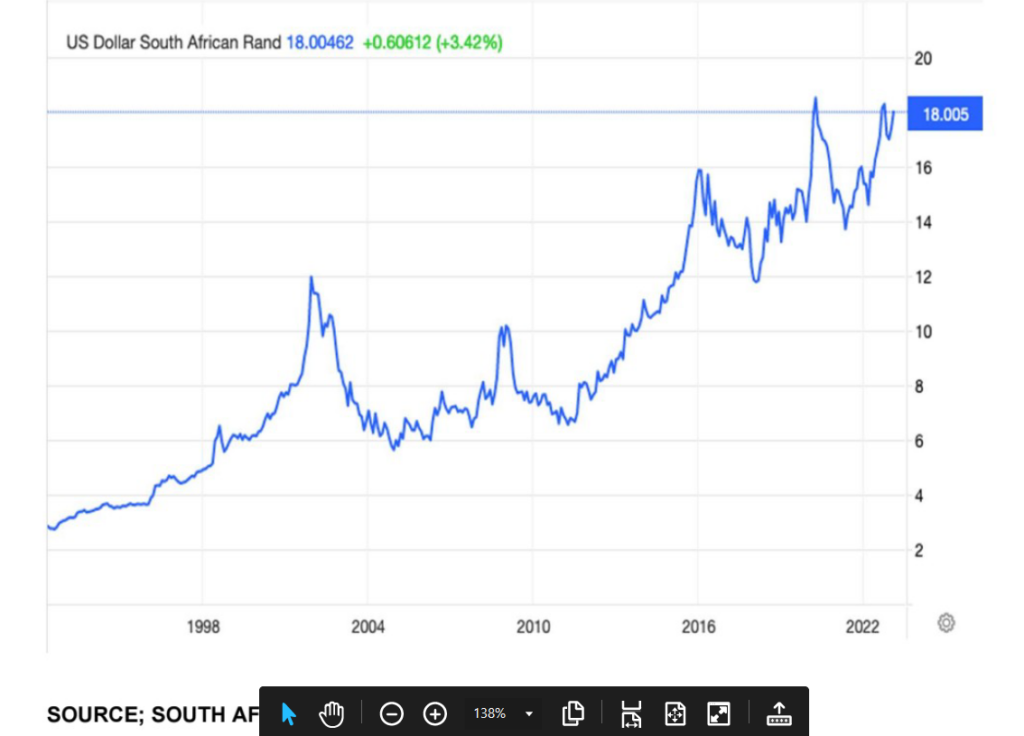
The impact of the drop is demonstrated by the increase in the number of Rands required to acquire a $1. To acquire $1 in 1994 it required R4, whereas it now requires over R18.
The consequences, not felt by politicians and some of the elite, on the population is that we have all lost over 75% of our wealth in international terms, with fuel and many other essentials increasing in price of around 450% – a disaster for all and the unemployed in particular.
POLITICIANS ARE ALWAYS WORRIED ABOUT THEIR RELEVANCE. IF THEY ARE NO LONGER RELEVANT, THEY MAY NOT KEEP THEIR JOBS
It does not help foreign perceptions of South Africa when politicians make ridiculous statements – I remember receiving a call from a concerned African-American, after Bush had gone into Kuwait when our then minister of Defense made a comment to the effect that ‘South Africa would not be sending any troops’. The caller wanted to know: “Was Bush supposed to have a sleepless night?” or “Did she not know that we were completely irrelevant?” I tried to laugh it off, but he said it was serious “as it indicated to the world the calibre of leaders we had.”
Damaging evidence of unpunished corruption
The revelations of the Zondo Commssion and by Andre De Ruyter on endemic state corruption does not enhance our international reputation and all the great work done by president Mandela is currently down the drain. This behavior by African so-called leaders, one of the reasons why right-wing politicians like president Trump consider Africa a “shit hole” = painting millions of honest and highly intelligent Africans with the same brush.
The international financial consequence of having no moral compass – once so vigorously promoted by the late ANC supporter, Arch Bishop Desmond Tutu.
Currently the unconscionable backing of the Russian invasion and their murder of innocent Ukrainian people is another stain on our reputation in many parts of the world and demonstrates that the ANC is spineless and has lost its moral compass – but then we did send singers and ministers to praise Mugabe on his death after he had murdered 20,000 of their Ndebele relatives.
Our economic relevance
This graph overstates of share of global GDP – and one would have thought would lead us to copy solutions found elsewhere, instead of continuously reinventing the wheel. In 1995 the Australian state of New South Wales had a computerized ordering system that would only print and order if the price was within 10% of the nationally agreed prices per item – imagine the tens of billions we would have had, had we simply looked at what the other 99.6% of the economic world was doing – if we had used the Australian system then and not waited until 2023, we would have saved billons.
Currently, our politicians and public officials, who lack a basic understanding of the financial impact of their behavior get away with this behavior and lack of accountability (except at election time when votes can be bought) are not constantly named and shamed with respective financial cost being hidden. The naming, shaming and eventual justice being ‘seen to be done’ would alter global opinion.
Our international standing in the US was diminished and has continued to slide – I remember a call from a US investment advisor, at the time of the Gulf War, when he asked me after our then minister of Defence said: “We will not send troops.” He asked me: “Was President Bush supposed to have a sleepless night?” Do you not know that internationally, you are completely irrelevant?”
Solutions for consideration
One of the possible solutions would be to get private sector funding to set up websites to name and shame perpetrators, show their photographs and set out the adverse economic consequence so as to enable small communities to use their mobile phones to get relevant content to add to local content of their own.
I feel sure that the head of Postnet and the manager of each port would not be enthusiastic about the economic cost of each “cock up” becoming a permanent record accessible to the voters. The same can be done when our Minister of Finance persists with fuel levies – do the rural communities know the financial effect on them and on employment if this was disclosed? They should know that when government levies an input cost it gets say R5 and the consumer pays R15.
The same site should also show photographs of the Zondo criminals (it can note that they had not yet been convicted in court) and the loss each one has caused to the economy. Including the effect on borrowings which currently stands at R1,000,000,000 a day.
The international community should also be encouraged to assist and the way in which they can do so is make loans conditional upon certain specified objectives having been met.
These objectives should include, inter alia:
-
- Preventing the misappropriation of funds – it may be a good idea for foreign funds to first be transferred into the banking accounts of local private sector trustees for release of funds only upon production approved contracts and credible documentary evidence that the conditions for payment have been met. This is particularly important insofar as the $8.5 billion funding to “transition away from coal” is concerned and stop any attempt by the ANC from requiring Eskom’s management that “to be pragmatic you have to (in order to pursue the greater good) you have to enable some people to eat a little bit.”
-
- Making loans conditional to an undertaking that further ‘bail out of State Owned Entities’ be banned as they are in the end, fund by foreign currency borrowings.
-
- Restricting the State from any involvement in the running of State Owned Entities.
-
- Evidence of action being taken against corrupt officials and an undertaking that dismissed employees will not be kept on payrolls for more than 3 months.
-
- Finally, the business community should stop funding the ANC and rather fund credible opposition parties