Introduction
“CULTURAL DIFFERENCES SHOULD NOT SEPARATE US FROM EACH OTHER, BUT RATHER CULTURAL DIVERSITY BRINGS A COLLECTIVE STRENGTH THAT CAN BENEFIT ALL OF HUMANITY.” ALSO: “INTERCULTURAL DIALOGUE IS THE BEST GUARANTEE OF A MORE PEACEFUL, JUST AND SUSTAINABLE WORLD.”
ROBERT ALAN (AMERICAN
WRITER, ARTIST AND SOCIAL ACTIVIST; 1922-1978)
DON BECK in The Crucible: Forging South Africa’s Future, sets out the difficulties in making progress if a large portion of the population, through different background and inadequate education and experience, are not sufficiently cognizant of the complexity of the issues at stake. He posits that there is an evolution of value systems created by answers to life’s challenges, each value/mindset creating its own socio/political system. The world has seen (and still sees) kinship bands, tribal orders, kingdoms, empires, authoritarian systems, capitalist democracies, social democracies, integrated networks and increasingly global structures, South Africa has an expression of all these mindsets, making it an extremely complex society, difficult to communicate with effectively, difficult to motivate to move in a particular direction, however positive.
Master code of human nature
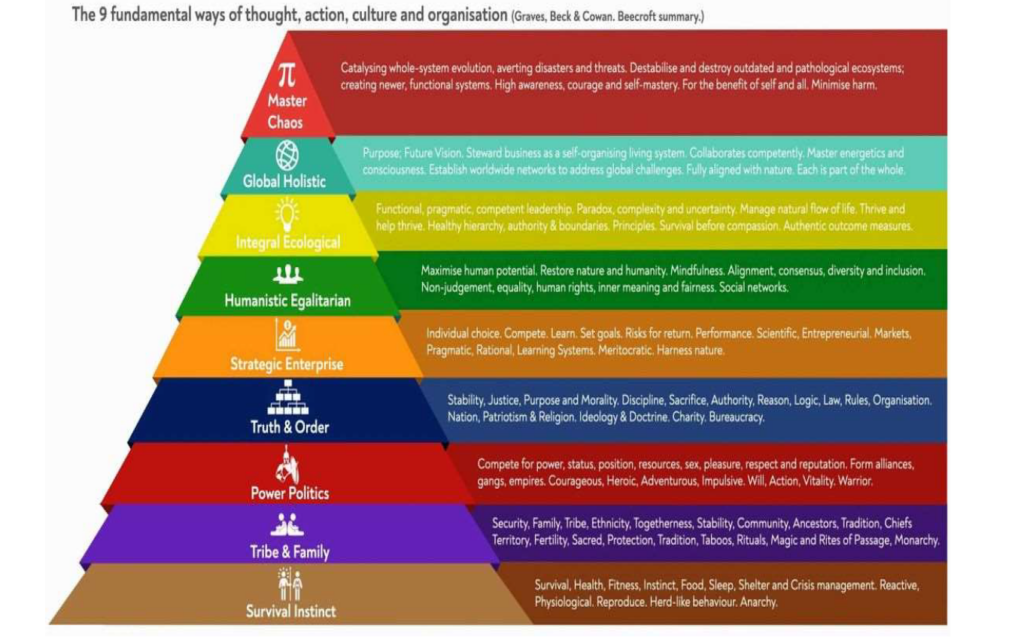
According to Beck, the art of bridging the different value systems as to how we think and behave is essential. As people’s behaviour is altered by changes in their circumstances, Beck’s recommendation for South Africa is that the building of housing on a massive and cost-effective scale ought to be a national priority (and not based upon ideology as to who should be the builder).
Beck characterized the various political parties and groupings I h n 1991 to give an idea of the complexity of South African society, the different world views and how differently they were likely to respond to political/constitutional proposals. Itgives an idea of the difficulty in achieving a national consensus and momentum.
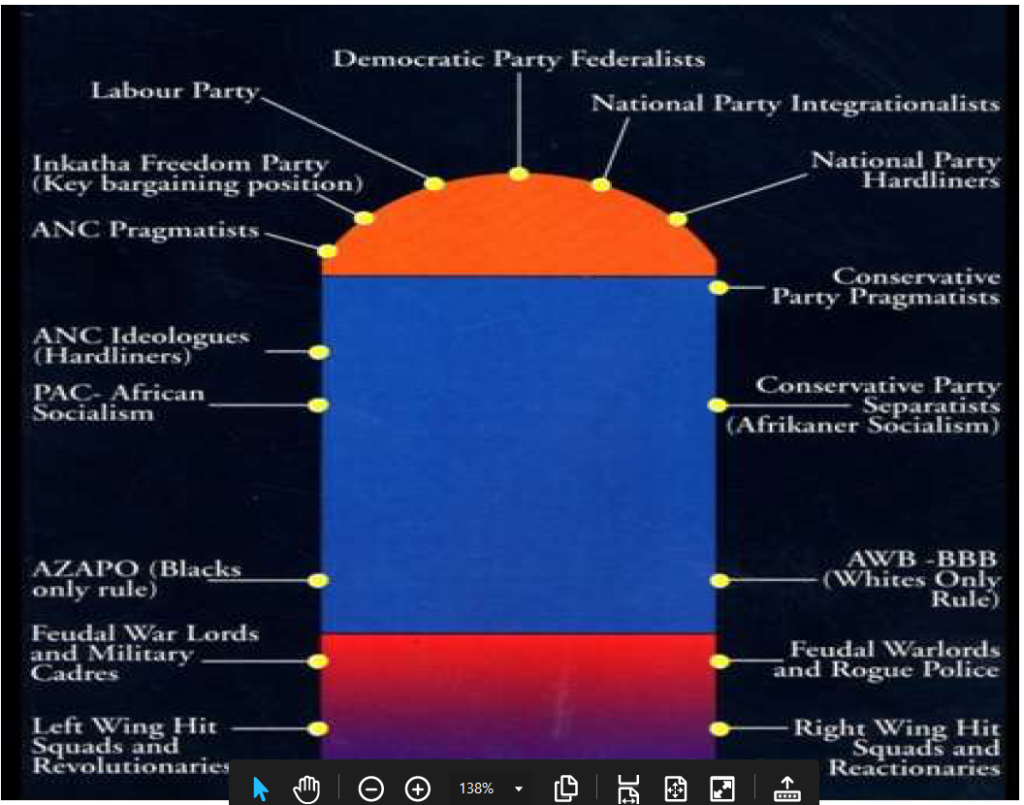
This graphic compiled before the political settlement of 1994 illustrates the political spectrum of South African society (from The Crucible: forging South Africa’s future). The labels have changed but the mindsets remain much the same today. What is interesting to note is that the black left wing and the white right wing behaved the same way.
The problems that arise in South Africa, and in many other parts of the world, are brought about by inability to bridge the gaps between our respective value systems. Within and probably because of, this diversity of value systems there is a destabilisation of belief structures in South Africa, which is a major constraint on the nation’s progress. On top of this we have the majority of South Africans poorly educated and with very little global experience with which to grasp global issues and our economic position in the world.
Socialistic policies & the enourmous influence of the SAPC
Our economic decline has been hastened by the ANC’s adherence in part to a failed socialistic model of which Winston Churchill said, “Socialism is a philosophy of failure, the creed of ignorance, and the gospel of envy, its inherent virtue is the equal sharing of misery”.
Capitalism
The business community has also failed to heed what Winston Churchill warned about capitalism when he said “The main vice of capitalism is the uneven distribution of prosperity. The mindless pursuit of profit is one of the reasons for our unemployment problems.
Educational Standards
“EDUCATION IS THE MOST POWERFUL WEAPON WHICH YOU CAN USE TO CHANGE THE
WORLD.” — NELSON MANDELA “FROM THE POOREST OF COUNTRIES TO THE RICHEST
OF NATIONS, EDUCATION IS THE KEY TO MOVING FORWARD IN ANY SOCIETY.” —
NELSON MANDELA “EDUCATION IS THE GREAT ENGINE TO PERSONAL DEVELOPMENT.”NELSON MANDELA
It also does not help that in South Africa, under the ANC educational standards have declined and to “achieve success” the pass mark was reduced to 30% – an insult to African children. The ANC has destroyed the future potential of more young Africans and inhibited them from participating in the economic world than Dr Hendrik Verwoerd, an architect of Apartheid could ever have done.
To quote that great lady Dr. Mamphela Ramphele, “education under Apartheid was better”.
Solutions to consider
- To avoid needless and endless discussion that leads to no or delayed action, the methodology developed by Adizes in the USA on how to have effective meetings pinning responsibility and deciding “who is doing what, when and how” should be adopted by the State and all entities controlled by it.
- The business community must be forced by for instance increasing the corporate rate of tax to 45%, what it was in 1994, with very substantial incentives being given to reduce the tax rate for taking steps to increase employment. There are many opportunities by for instance adding value to our exports. One example was put to me in Reunion in 1995 by the managing director of a seafood exporter when he said “You cannot have zee sea food dinner without zee fish- you export frozen fish”. The last I checked it appeared that zero added value hake and other fish annual exports were R2 billion a year, versus a potential R20 billion. It is in adding value that multiple business and employment opportunities arise for farmers growing vegetables and spices and companies preparing the meals and suppliers foil, high quality colour printed packaging etc. I am sure there are many other opportunities for local (or in their absence foreign investors) to substitute value added exports instead of our current exports of gold bullion- instead of hollow gold chain jewellery as the Italians do. Likewise, we could possibly export wood products instead of saw dust and wood chip, cut granite tiles instead of 5–25-ton blocks etc, etc.
- To reduce the gross inequality in earnings between short-term thinking over- incentivised management and the remuneration and share options issued to them must be set by shareholders. The price of executive share options should be based on the average of the past 5 years share prices – not on short term dips in prices with vesting only after 10-15 years. It is unconscionable to reward executives for huge increases in profits earned when those results arise massive increases in commodity prices, uninfluenced by them.